Open Ticket
  +373 79 600002
  Telegram Live Chat
  F.A.Q
F.A.Q  English
 Русский
  Română
  Deutsch
  Français
  Türkçe
  Español
  Português
  Українська
  български
  Polski
  Indonesia
  中文 (中国)




















































































 on All Hosting Services




How to Install Linux Mint from USB: A Complete Step-by-Step Guide
Linux Mint is one of the most popular and user-friendly Linux distributions available today. It's fast, stable, completely free, and — perhaps most importantly — it feels immediately familiar to anyone migrating from Windows. Whether you're setting up a personal workstation, a development machine, or exploring Linux for the first time, this guide walks you through exactly how to install Linux Mint from a USB drive, from preparation to first boot, with no prior experience required.
What You Need Before You Start
Before diving in, gather the following:
- USB flash drive — minimum 4 GB capacity (8–16 GB recommended for better write speeds and reliability)
- A working computer with internet access — to download the ISO and necessary tools
- Linux Mint ISO file — the official installation image (essentially a digital copy of the OS)
- Bootable USB creation software:
- Rufus — for Windows users
- balenaEtcher — for macOS or Linux users
- A backup of all important files — if you plan to erase your existing system, all data on the target drive will be permanently deleted
> AlexHost Pro Tip: If you're running a VPS Hosting plan or a Dedicated Server with AlexHost, you can mount the Linux Mint ISO directly through your hosting control panel and perform a full remote installation — no USB drive needed whatsoever.
Step 1: Download the Linux Mint ISO
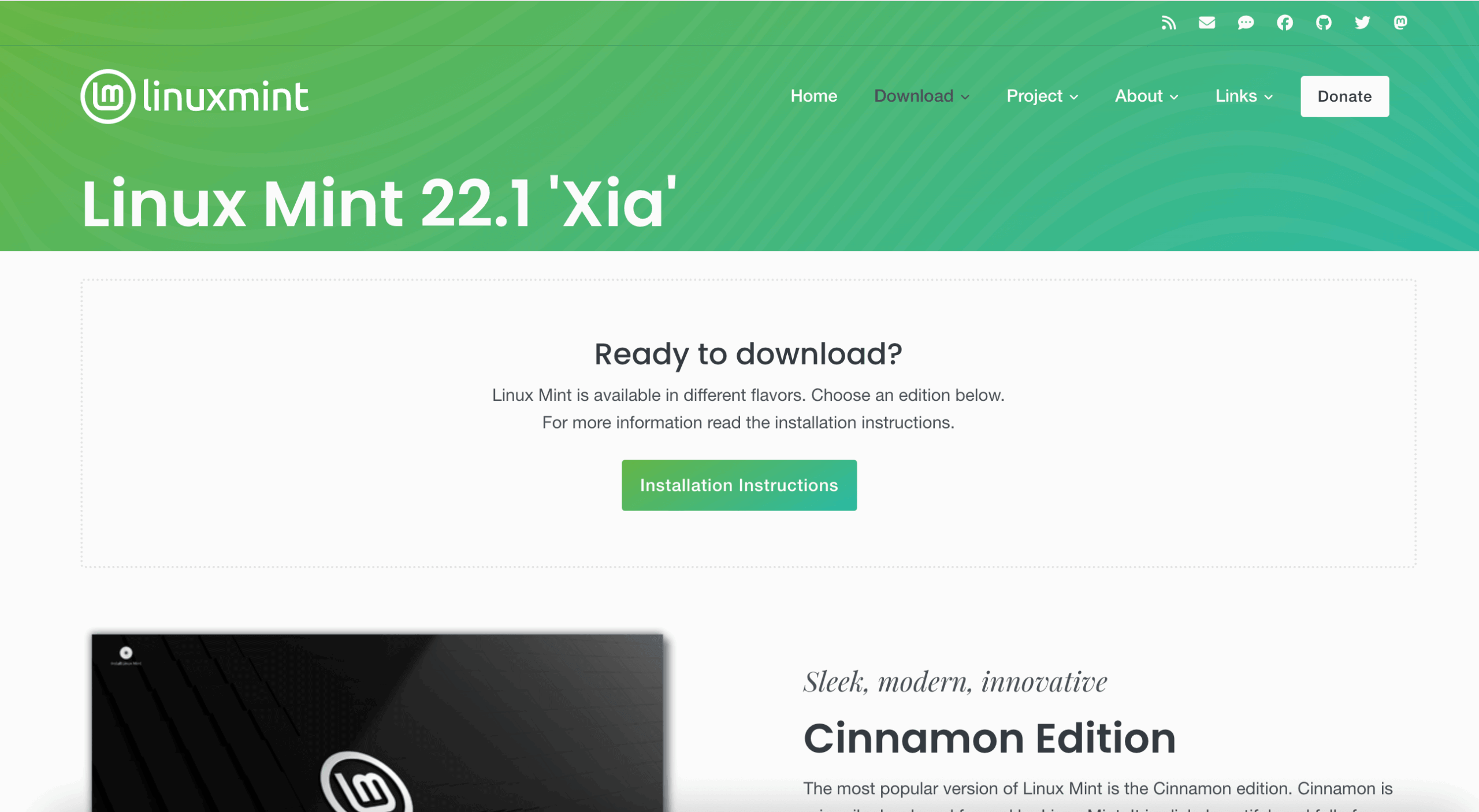
- Navigate to the official Linux Mint website (linuxmint.com)
- Choose the edition that best fits your hardware and preferences:
| Edition | Best For |
|---|---|
| Cinnamon | Modern hardware; full-featured desktop experience (recommended for most users) |
| MATE | Older or mid-range hardware; lighter on system resources |
| Xfce | Very old or low-spec machines; the most lightweight option |
- Click Download and select a mirror server geographically close to your location for the fastest download speeds
- Save the
.isofile to a known location on your computer
Step 2: Create a Bootable USB Drive
A standard USB drive cannot install an operating system on its own — it must first be made bootable, meaning your computer's firmware can recognize it as a valid startup device.
On Windows — Using Rufus
- Download and launch Rufus (rufus.ie)
- Insert your USB flash drive into an available port
- Under Device, select your USB drive from the dropdown menu
- Under Boot selection, click SELECT and locate the Linux Mint
.isofile you downloaded - Set the Partition scheme:
- Choose GPT if your PC uses UEFI (standard on most computers made after 2012)
- Choose MBR if your PC uses Legacy BIOS (common on older hardware)
- Leave all remaining settings at their defaults
- Click START — confirm that you accept erasing all data currently on the USB drive
- Wait for Rufus to complete the process (typically 5–10 minutes)
On macOS or Linux — Using balenaEtcher
- Download and open balenaEtcher (balena.io/etcher)
- Click Flash from file and select your Linux Mint
.iso - Insert your USB drive and select it as the target
- Click Flash! and wait for the operation to finish
> Important: The flashing process completely erases everything on the USB drive. Ensure you have backed up any files stored on it before proceeding.
Step 3: Boot Your Computer from the USB Drive
- Insert the bootable USB drive into the computer on which you want to install Linux Mint
- Restart (or power on) the machine
- Immediately press the appropriate key to open the Boot Menu — this varies by manufacturer:
| Manufacturer | Common Boot Menu Key |
|---|---|
| Dell | F12 |
| Lenovo | F12 |
| HP | Esc, F9, or F10 |
| ASUS | F8 or Esc |
| Acer | F12 or Esc |
| MSI | F11 |
- From the boot menu, highlight your USB drive and press Enter
> Tip: If you cannot find the boot menu key for your machine, a quick web search for your specific model number will provide the answer instantly.
Step 4: Test Linux Mint in Live Session Mode (Recommended)
When Linux Mint loads from the USB, it starts in Live Session mode — a fully functional, temporary environment that runs entirely from the USB without touching your hard drive.
Use this opportunity to verify:
- ✅ Wi-Fi connectivity
- ✅ Audio output
- ✅ Keyboard and touchpad/mouse responsiveness
- ✅ Display resolution and graphics rendering
- ✅ Any peripheral devices you rely on
If everything functions correctly, you're ready to proceed with the permanent installation. This step is optional but strongly recommended — it can save you significant troubleshooting time later.
Step 5: Run the Linux Mint Installer
- On the Live Session desktop, double-click the Install Linux Mint icon
- Select your language and click Continue
- Choose your keyboard layout and click Continue
- Connect to Wi-Fi if available — doing so allows the installer to download the latest updates and language packs during installation, saving time afterward
- On the Installation type screen, choose the option that matches your situation:
| Option | What It Does |
|---|---|
| Erase disk and install Linux Mint | Wipes the entire drive and installs a clean copy of Linux Mint |
| Install alongside existing OS | Sets up a dual-boot configuration, preserving your current operating system |
| Something else | Enables full manual partitioning — recommended only for advanced users |
- Select your time zone on the map
- Create your user account:
- Enter your full name
- Choose a username (lowercase, no spaces)
- Set a strong, secure password
- Click Install Now and confirm any prompts about disk changes
- Wait for the installation to complete — this typically takes 10–20 minutes depending on your hardware
- When prompted, click Restart Now
- Remove the USB drive when the screen instructs you to do so, then press Enter
Step 6: Essential First Steps After Installation
Once Linux Mint boots from your hard drive for the first time, take a few minutes to complete these important post-installation tasks:
Update Your System
Open the Update Manager from the taskbar or application menu and install all available updates. This ensures you have the latest security patches and software improvements.
Install Hardware Drivers
Launch the Driver Manager (found under Administration in the main menu) to detect and install proprietary drivers for your graphics card, Wi-Fi adapter, and other hardware components.
Customize Your Desktop
Linux Mint is highly customizable. Explore System Settings to adjust themes, icon packs, wallpapers, panel layout, and more to suit your preferences.
Install Applications
Open the Software Manager to browse and install thousands of free applications — from web browsers and office suites to development tools and multimedia software.
Running Linux Mint in the Cloud with AlexHost
If you'd prefer not to install Linux Mint on local hardware — or if you need a remotely accessible Linux environment — AlexHost has you covered. Our VPS Hosting and Dedicated Servers support custom ISO mounting, allowing you to install Linux Mint (or virtually any Linux distribution) directly from your control panel in just a few minutes.
For users who want a managed environment with an intuitive graphical interface, our VPS with cPanel and VPS Control Panels options provide powerful tools for server management without requiring deep command-line expertise.
Need a domain to go with your new Linux server? Check out Domain Registration at AlexHost for competitive pricing and seamless DNS management.
Frequently Asked Questions
Can I install Linux Mint without erasing Windows?
Yes. Choose the Install alongside option during installation to set up a dual-boot configuration. You'll be able to choose between Windows and Linux Mint every time you start your computer.
What is the minimum hardware required for Linux Mint?
Linux Mint Cinnamon requires at least 2 GB of RAM and 20 GB of disk space. For the Xfce edition, 1 GB of RAM is sufficient, making it viable on very old machines.
Is Linux Mint safe to use?
Absolutely. Linux Mint receives regular security updates and has a strong track record of stability. It also benefits from the inherent security advantages of the Linux architecture.
Can I try Linux Mint before committing to the installation?
Yes — that's exactly what the Live Session mode (Step 4) is for. You can use Linux Mint fully from the USB drive without making any changes to your computer.
Final Thoughts
Installing Linux Mint from a USB drive is a straightforward, well-documented process that virtually anyone can complete by following the steps outlined above. The result is a fast, reliable, and completely free operating system that excels for everyday computing, software development, graphic design, and even lightweight server management tasks.
Whether you're installing it on aging local hardware to breathe new life into it, setting it up as a dual-boot alongside Windows, or deploying it on a cloud-based VPS Hosting or Dedicated Server environment, Linux Mint delivers a polished and capable Linux experience that's hard to beat.