Open Ticket
  +373 79 600002
  Telegram Live Chat
  F.A.Q
F.A.Q  English
 Русский
  Română
  Deutsch
  Français
  Türkçe
  Español
  Português
  Українська
  български
  Polski
  Indonesia
  中文 (中国)






































































































































 on All Hosting Services






What Is Jev? TypeSafe AI’s Decision Model Explained
Jev in One Minute: AI Decisions, Not Another Chatbot
A customer says their subscription renewal appears twice and asks for money back. Your support application needs a department and a refund-request flag, not an essay. Jev by TypeSafe AI is a decision model that interprets supplied information and returns answers from a set you define. It works inside an application, not as an autonomous support agent.

Think of a sorting desk with predefined department trays and a rating card. Jev chooses a tray, rates the message against described levels, and returns probabilities alongside its judgments. It does not compose replies or write code. The desk can still put a message in the wrong tray: restricting possible answers does not make every answer correct. Your application controls the next step, including human review.
TypeSafe announced Jev in public early access on September 15, 2026. Its launch drew attention by proposing a different place for AI: everyday software decisions rather than another chat window. Assessing that promise means separating useful workloads from headline numbers—and hosting your application from hosting Jev itself.
How Jev Differs from an LLM—and from Ordinary Rules
Code can check whether a transaction settled or an account has permission. Interpreting “please return the extra payment” requires semantic judgment: understanding meaning rather than checking an exact condition. A large language model (LLM) can generate text, code, and structured responses, including classifications. Jev focuses on questions such as which department should receive a message. Its typed output uses an agreed answer kind and allowed values. That fixes the label’s form, not whether it fits the message.
For example: A customer writes, “You charged me twice. Please return the extra payment.” Code checks whether two charges settled. Jev could route the message to billing from the allowed departments: billing, technical, or account. An LLM could draft a reply.

| Approach | Main job | Output | Best fit |
|---|---|---|---|
| Ordinary rules | Evaluate exact stated conditions without interpreting intent | Computed values or predefined code branches | Arithmetic, permissions, and known business logic |
| Generative LLM | Writing and flexible reasoning; also classification | Generated text or schema-constrained structured results | Open-ended tasks, drafting, code generation, and extended reasoning |
| Jev | Interpret supplied information using descriptions of allowed answers | Choice, Score, or a yes probability | Repeated judgments where possible answers can be defined upfront |
Modern LLMs can classify and adhere to supported output schemas. Traditional task-specific classifiers already handle many fixed-label jobs. Jev’s proposition is specialization and questions configurable in natural language, not the invention of classification or exclusive ownership of structured answers. You describe the judgment in words rather than training a separate classifier for each new question.
TypeSafe calls this a “System One” model, inspired by fast, intuitive judgment. This is its terminology, not an independent scientific category or evidence of human cognition. TypeSafe says its training method, Reinforcement Learning for Calibrated Decisions (RLCD), aims to make assigned probabilities reflect outcomes and uncertainty. That objective does not establish reliability on every workload.
How Jev Works: Context In, Three Kinds of Answer Out

An application programming interface (API) lets application code send requests and receive responses. With Jev, the app supplies state—information about the situation—and questions. State is not persistent memory: Jev does not browse, fetch billing records, or automatically remember earlier requests.
Consider this invented message: “My subscription renewal appears twice on my card statement. Please return the extra payment. I’m annoyed that I have to follow up again, but I’d appreciate your help.” The charge remains a customer claim. Criteria define the categories or descriptive levels used to judge it. Jev’s three primitives, or small building blocks, cover these question types:
| Question type | Question and allowed answers | What comes back |
|---|---|---|
| Choice | Which department? Billing: charges/refunds/subscriptions; technical: broken features; account: sign-in/profile/access | Selected option, probabilities for each option, and confidence |
| Score | Expressed frustration? 0: neutral, no annoyance; 1: annoyed but constructive; 2: hostile wording or threat to cancel | A 0–2 score calculated from the level probabilities, plus a level legend, probabilities, and confidence |
| Noul (API’s name for a yes/no probability) | Explicitly asks for money back or account credit? A billing complaint alone does not qualify | Yes probability from 0 to 1; no separate native confidence field |
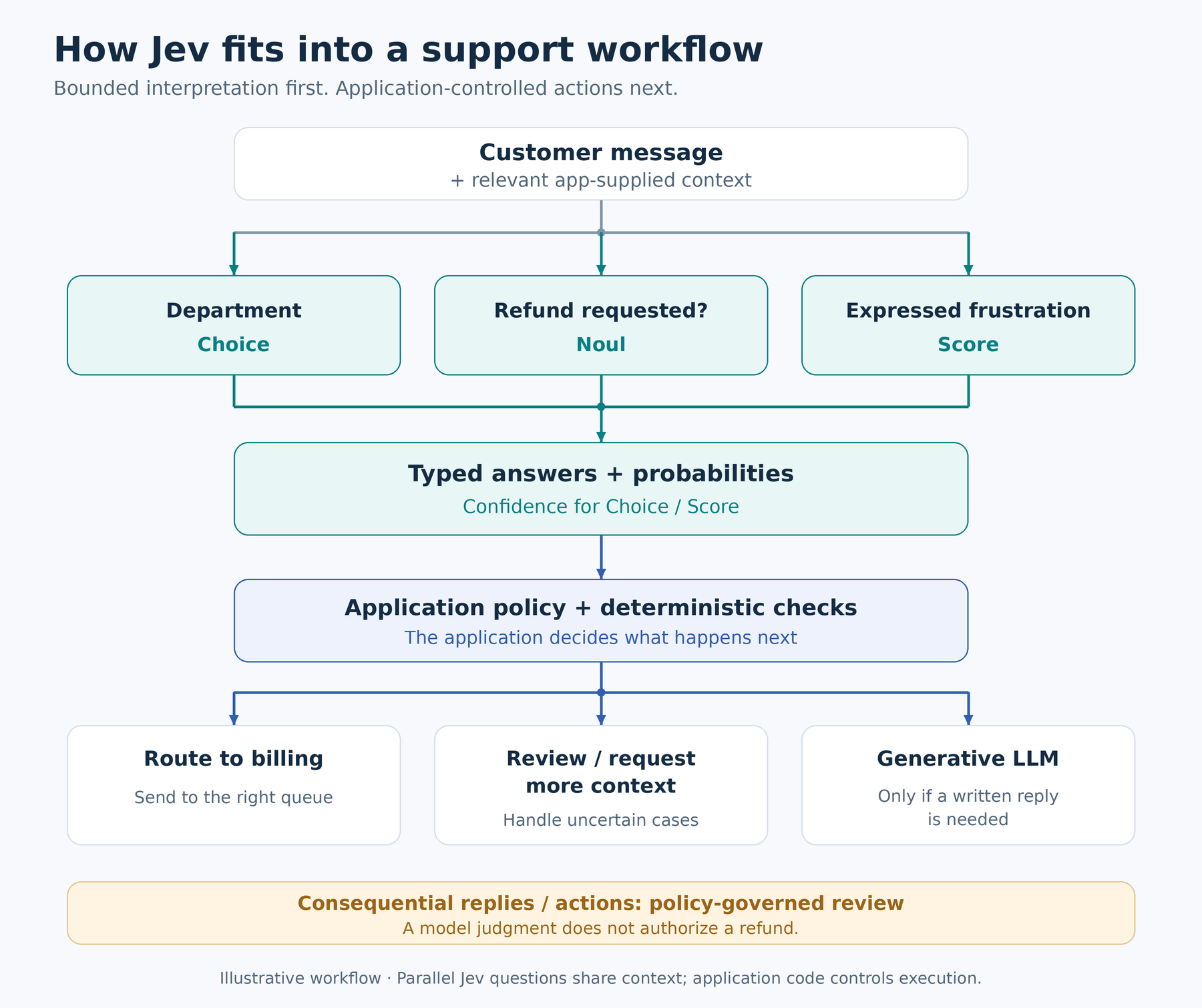
All three receive the same supplied context. The application then combines their results and sends uncertain cases for review; reply drafting is handled separately. Questions run in parallel against shared state; none reads another’s answer in that call. This does not make customer properties or prediction errors statistically independent. A Score can fall between levels because it averages their numbers using their probabilities. Here it describes expressed frustration—not urgency, transaction value, or refund eligibility.
If an answer determines which records to retrieve or options to offer next, the dependent question requires a later request. Additional questions increase billable input. Each request also has a limit on how much text it can accept, so you cannot keep adding questions indefinitely. Real department lists also need an other/none or review path for messages outside these three categories.
What You Can Actually Do with Jev

In the support workflow, a billing label could send the message to the right queue, while a refund-request flag tells staff what the customer wants. The frustration rating could help prioritize follow-up or human review alongside the ticket’s other details. These are illustrative uses, not observed Jev results; urgency and financial impact need their own evidence.
Billing investigation follows a different path: the application retrieves authoritative payment records and checks for a duplicate settled charge. Refund execution must satisfy exact policy checks and verify identity and authorization, with appropriate approval. A strong model prediction does not change those requirements. Reply drafting belongs to a separate component. A civil customer can be entitled to a refund, and an angry customer can be mistaken. Sentiment stays out of entitlement checks. Other code-controlled workflows divide the work similarly:
| Workflow | What Jev decides | What stays outside Jev |
|---|---|---|
| Model/tool routing | Choose among named options using the supplied request and selection criteria | Code invokes the selected service, validates arguments, and handles fallback or unavailable options |
| Passage reranking | Rate relevance of already retrieved passages so candidates can be reordered | Retrieval supplies candidates; code orders them; another component writes and verifies the answer |
| Bounded extraction/tagging | Choose a document label or matching candidate field value, including “not stated” | A parser or another model finds candidate values; code validates and assembles the record |
| Action/text-alert review | Flag a stated risky meaning or policy concern in supplied action descriptions or alerts | Permissions, sandboxing, exact checks, and human/security review remain separate controls |
For businesses, potential savings come from reducing repetitive sorting, but Jev is not an out-of-the-box no-code operations manager. An integration owner must define categories and label representative examples. Those examples help measure whether errors and review work outweigh the savings. Existing reliable rules remain useful; the opportunity is in messages those rules cannot interpret well.
Self-hosters could add interpretation to an existing helpdesk, queue, or document workflow without owning the model locally. Security screening is supplementary review: it does not replace a firewall or antivirus. Nor is it a complete attack detector or a boundary for granting authorization. TypeSafe’s documented adversarial-content limitation means malicious text can influence this reviewer too. A flagged concern invites investigation; an unflagged input is not a safety certificate.
Why the Launch Attracted Attention—and How to Read the Numbers
Jev’s numbers are a reason to evaluate it, not a forecast for your application. In high-volume sorting and interactive routing, small costs and delays add up. Parallel judgments, low input pricing, and no output-token charge explain its appeal. LangChain’s integration discussion and Browserbase’s implementation report show developer interest, not universal adoption or production maturity.
In its launch evidence, TypeSafe reports 70–500 ms end-to-end responses and workflow comparisons roughly 194× faster and 445× cheaper. It describes the headline gains as toward the high end of expected real-world improvements. They are not universal multipliers or a service-level guarantee.

TypeSafe built its own test workflows, using other models’ probabilities rather than independently labeled factual ground truth.
- West Coast testing, short demo inputs that favored Jev, and comparison wrappers and settings also limit how broadly the results apply.
- Browserbase’s September 21 report offers a concrete hybrid example: early Stagehand Act median latency fell from 1.97 to 0.46 seconds—about 4.3× faster—with Jev selecting bounded candidates, Stagehand executing in code, and an LLM handling fallback. This implementer-reported result is not an independently reproduced or general-purpose benchmark.
📝 Note — input pricing is not total system cost: As checked on October 5, 2026, TypeSafe lists jev-1.13.0 at $0.042 per million input tokens, with no output-token charge. Tokens are text chunks—not requests or exact word counts—and billable input includes state and questions.
Hypothetically, 100,000 requests × 1,000 input tokens = 100 million tokens, costing $4.20. Retries, other model calls, hosting, engineering, and human review add costs. Repetitive judgments may be economical if quality and fallback rates are acceptable; this example is neither a complete-system quote nor a guaranteed return.
What Probabilities and Confidence Really Tell You
- Probability expresses how likely the model considers an answer: billing rather than technical support, or yes to the refund-request question.
- Calibration describes how those estimates match outcomes across representative predictions.
For a calibrated 80% rain forecast, rain should occur on roughly 80% of comparable occasions assigned that probability. Likewise, roughly 80% of predicted labels in that probability group should be correct—not necessarily any particular label. TypeSafe describes calibration-oriented training; your workload still needs validation.
Choice and Score also return confidence, a statistic derived from how probability is spread across the answers. An illustrative—not measured—three-option Choice with a top probability of 0.90 has confidence 0.85 under the current documented rule. The first estimates how likely the answer is; the second shows how clearly it beats alternatives. Confidence is not a separate fact-check or an 85% probability of correctness.

A Score describes position on your scale: low frustration can be predicted with high confidence. A middle score can reflect probability concentrated at the middle or split between opposite extremes, so inspect the distribution. Noul near 0.5 means yes/no ambiguity, not medium frustration. Its yes probability carries the uncertainty; there is no native confidence field.
Warning — validate before automating: A cutoff copied from another workload may not suit your messages. Use representative examples with known labels to check both prediction errors and how often cases need review or fallback.
Use those results to decide which messages can be routed automatically, which need confirmation, and which require human review. The cutoff should reflect the consequences of a mistake: misrouting a reversible ticket differs from authorizing a payment. This makes confidence useful as a routing signal, with the threshold chosen for your task rather than treated as a universal number.
What Jev Cannot Do—and What the Hype Leaves Out
TypeSafe’s “can’t hallucinate” claim describes the output format. For practical reliability, the relevant questions are where Jev struggles and how failures show up. An incorrect prediction needs a different response from a failed API request. If the prediction was correct, a failure may lie in how application logic used it.
The constrained interface also rules out asking Jev for prose, code, or an explanation of its reasoning. For those outputs, use a generative LLM. On the input side, Jev accepts text, including supported JSON structures—not direct images, audio, or video. Working with media requires a separate preprocessing service to supply text or structured fields.

Exact arithmetic, counting, and date comparisons belong in code. Extended multi-hop judgments are also a poor fit. For extraction, Jev selects candidates or components you supply; it does not freely generate arbitrary strings or reconstruct a refund amount from a Score. TypeSafe’s Jev 1.13 limitations, reviewed October 2, 2026, group several other practical weaknesses:
- Wording and criteria: Literal readings, indirection, and contradictory criteria can mislead the model. Use narrow, explicit questions with aligned descriptions.
- Context: Irrelevant state can distract it. Retrieve and filter first rather than sending every available record.
- Inputs and options: Adversarial text and option ordering can affect answers. Test malicious inputs and reordered options; these tests do not confer immunity.
Current model documentation says English performs best; evaluate other languages on your own content. It also lists exact context limits: capacity is bounded, and a large window does not guarantee perfect attention. Version aliases can move without an application change, so reassess tuned thresholds when versions change. Customer-specific additional model training is not currently offered; you shape domain behavior through context and question criteria.
Can You Self-Host Jev? Where a VPS Fits
Inference means running a model to answer a request. As checked on October 5, the documented public offering serves Jev inference through TypeSafe’s API. The reviewed docs provide neither public downloadable model weights nor a standard local deployment path. Open integration code is not open model weights: you can self-host the application, but Jev remains external.
A VPS, or virtual private server, can host the surrounding application. An appropriately sized AlexHost VPS can run the backend or workers that call Jev. It can also host the application’s queue, database, or review interface. Model access and API charges are separate. You need neither a server purchase nor a GPU to try the hosted service; size hosting for application traffic and local workloads, not Jev inference.
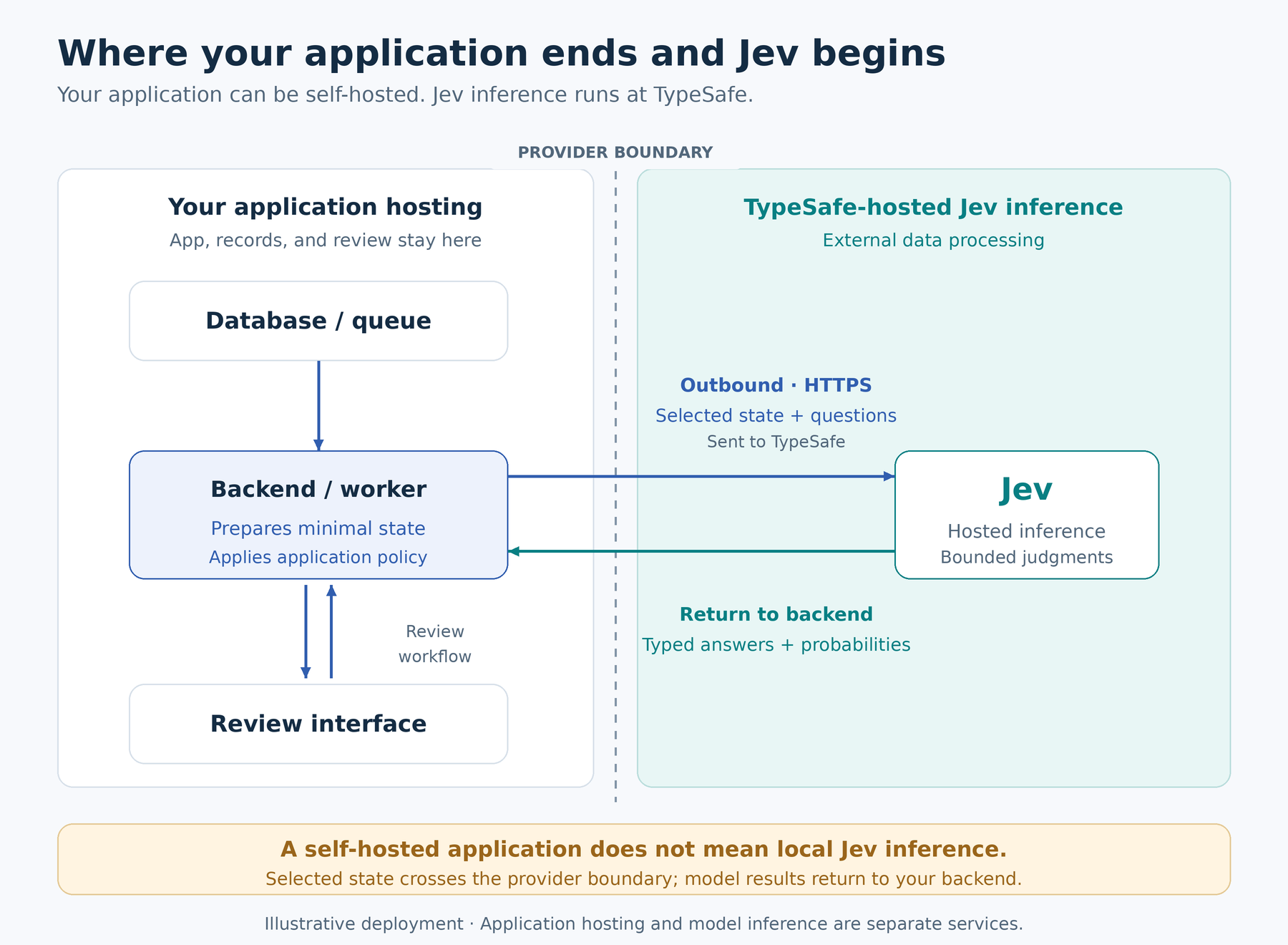
The app, records, and review interface can run on your server, while selected context crosses to TypeSafe for inference and decisions return to the backend.
Warning — a self-hosted app does not mean local inference: Selected state leaves your hosting boundary. No-training commitments do not imply default zero retention. Check the applicable provider terms before sending sensitive information through this workflow.
TypeSafe’s privacy policy rules out training or fine-tuning on inputs. It also describes US hosting and allows retention as reasonably necessary. Its legal overview offers enterprise zero data retention (ZDR) subject to applicable terms. For personal-data workflows, the data-processing agreement addresses processing and international transfers; server location is only part of the decision.
Send only the context needed for the decision, leaving out secrets and unnecessary personal data. Protect provider keys and keep access controls in place. Keep a timeout/rate-limit fallback, such as queuing for review; handle failed requests separately from uncertain answers. As the application operator, you remain responsible for patching and monitoring. Backups and workflow policy also stay with you.
Who Should Consider Jev—and Who Should Skip It?

Jev brings semantic judgment into software through questions with predefined answers.
- It can route a customer message
- Rate a passage’s relevance
- Estimate whether a request meets stated criteria, returning typed results and probabilities that application code can use.
Its appeal lies in making these repeated decisions fast and inexpensive. The practical value still depends on clear criteria, relevant context, and performance on your own examples. Constrained answers can be wrong, and probabilities help guide review rather than guarantee correctness.
For the customer asking to “return the extra payment,” Jev’s role is to recognize the request and help send it to the right place. Records, permissions, and refund execution remain with the application. Start with a small, reviewable workflow using the hosted API, then measure accuracy, fallback needs, and total cost. That is where Jev’s promise becomes concrete: useful judgment connected to a well-defined next step.